Time Zone Converter
Meeting Planner for Any Zone
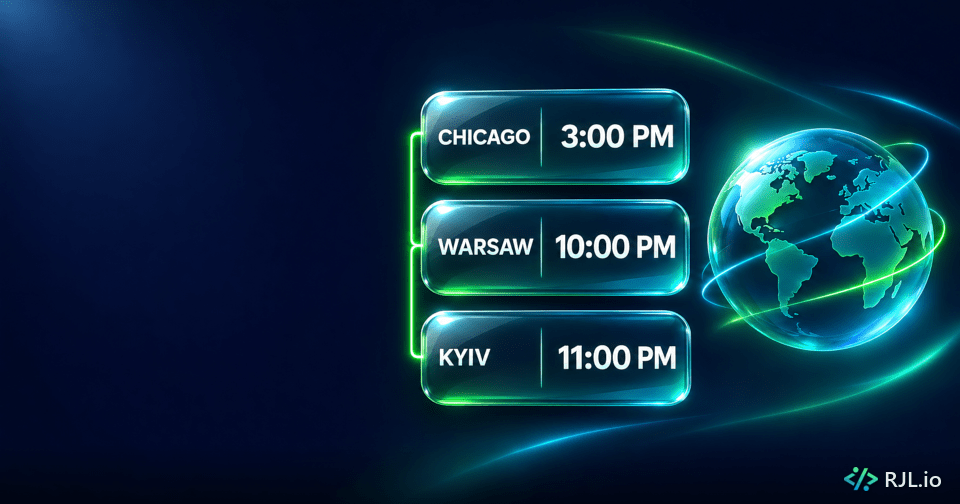
What time is 3:00 PM in Chicago in Warsaw and Kyiv? Pick a date, time and zone, add every city you need, and see the same moment everywhere with UTC offsets, abbreviations and next-day flags, plus an hour grid that shades working hours and highlights the best overlap. Daylight saving is handled for you. 100% client-side. Zero data stored.
Time Zone Converter Tool
The moment
Add a zone
Quick add
Same moment, every zone
| Zone | Local time | Zone name and offset | Day | Remove |
|---|
In UTC: . For epoch seconds and milliseconds, use the Timestamp Converter. Want the current UTC time always in view? NowUTC is a free UTC clock you can pin beside your work.
Meeting planner
Each column is one hour starting at midnight in the source zone on the chosen date. A shaded cell means a one-hour meeting starting then fits inside working hours there. A column outlined in green works for everyone.
Common Use Cases
Remote team meetings
Line up Chicago, Warsaw and Kolkata on one grid and find the one hour when everyone is at work, instead of trading messages about whose evening it is.
Webinars and launches
Announce an event in several zones at once. Copy the plain-text summary into an email or post, with each zone's name and UTC offset spelled out.
Travel and calls home
Check what time it will be at home when you land, or whether a call with family on the other side of the world will wake anyone.
Support and on-call hours
Set the working hours to a support shift and see how the shifts in different zones cover the day, with daylight saving applied on the date you choose.
Clock-change weeks
The United States and Europe change their clocks on different dates, so the gap between Chicago and Warsaw is 7 hours most of the year and 6 for a few weeks. Pick the actual date and see it.
Shareable links
Copy a link that opens with the date, time and zones already filled in, so everyone you send it to sees the same conversion in their own browser.
How Time Zones Work
UTC and offsets
UTC is the reference every zone is measured against. A zone's offset is how far its clocks are ahead of (+) or behind (-) UTC, such as UTC-06:00 for Chicago in winter or UTC+05:30 for India. The offset is not fixed: it changes when a zone moves its clocks.
IANA zone names
Zones are named by region and city, such as America/Chicago or Asia/Kolkata. A name stands for a place's whole history of offsets and clock changes, which is why "Chicago" is more precise than "CST". Use the name, not an abbreviation, to schedule anything in the future.
Daylight saving time
Many zones move their clocks forward in spring and back in autumn, and different regions change on different dates. This tool asks your browser for the offset in force on the exact date you pick, so it is right for a date next summer as well as today. Rules that governments change after your browser was released can be wrong until it updates.
Skipped and repeated hours
When clocks go forward, one hour does not exist (2:30 AM on the day Chicago springs forward). When they go back, one hour happens twice. The tool tells you when your time is one of these, moves a skipped time forward, and uses the first of a repeated time.
Half-hour and 45-minute zones
Not every zone is a whole number of hours from UTC. India is UTC+05:30, Nepal UTC+05:45, and parts of Australia and Canada use half-hour offsets. In the planner those zones show times ending in :30 or :45, and a one-hour meeting is checked against its own working hours.
Reading the planner
Columns run for 24 hours from midnight in the source zone. A cell marked +1d is already on the next calendar day in that zone. The best overlap is the longest run of columns that works for every zone. When none does, the planner names the hour that works for the most zones.
From the same developer
Keep UTC on screen with NowUTC
This page converts one moment between zones. NowUTC.com is its always-on companion: a live UTC clock for reading logs, timing deployments and working with teams in other zones. It is free, needs no account, and keeps your settings in your own browser.
- Live UTC clock in a small window you can pin
- Your favorite time zones beside UTC
- Copy the time as ISO 8601, Unix epoch, RFC 2822 or SQL
- Convert a local date and time to UTC
Opens nowutc.com, a separate site, in a new tab.
Pro Tip: URL Parameters
Pre-fill the tool with /timezone-converter/?time=2026-12-01T15:00&from=America/Chicago&to=Europe/Warsaw,Europe/Kyiv. time is the local date and time in the source zone as YYYY-MM-DDTHH:MM, from is the source zone and to is a comma-separated list of zones to compare. Use the IANA names. Anything that is not a real zone is ignored.
The address bar updates as you change anything, so "Copy link" gives you a link to the exact meeting you are planning.
Frequently Asked Questions
Choose the date, the time and the zone it is in, then add the zones you want to compare with the search box or the quick-add buttons. Every row shows the same moment as that zone's local time and date, its name and its offset from UTC, and flags next day or previous day when the date differs.
Yes. The offset for each zone is looked up for the exact date and time you choose, using the time zone database built into your browser, so the result is right across clock changes. Rows in daylight time are labeled, and nothing is calculated from a fixed offset.
Regions change their clocks on different dates. The United States moves forward in March, weeks before Europe, so for a few weeks Chicago and Warsaw are 6 hours apart instead of 7. It happens again in autumn. Pick the real date of your meeting rather than assuming the usual gap.
When clocks go forward, an hour is skipped, so 2:30 AM on that day in Chicago never happens. The tool moves it forward to the first valid moment and tells you. When clocks go back, an hour is repeated, so 1:30 AM happens twice. The tool uses the first one and tells you.
For each hour of the day it checks whether a one-hour meeting starting then fits inside the working hours (9 to 17 by default, and you can change them) in every zone. The longest run of hours that works for everyone is the best overlap. If there is none, it shows the hour that works for the most zones.
Abbreviations such as CST or PDT are not standard, and the same letters can mean different zones. Your browser only gives a short name where one is widely used in your language, and otherwise shows the offset, such as GMT+1. The UTC offset shown beside it is always exact.
Any zone your browser knows, which is several hundred. Search by city, by country, by zone name such as America/Denver, or by common names like PST or India. A city that is not a zone of its own uses the zone of the largest nearby city in the same region, such as Chicago for most of the central United States.
Add URL parameters, for example /timezone-converter/?time=2026-12-01T15:00&from=America/Chicago&to=Europe/Warsaw,Europe/Kyiv. The time parameter is the local date and time in the source zone, from is the source zone and to is a comma-separated list of zones. The address bar updates as you work, and Copy link copies it.
No. All conversions use the time zone data already in your browser, and nothing is uploaded, logged or saved. The only thing that changes is the address bar on your own device, so a link you copy can be shared. The values are gone when you close the page.
Why We Built This Time Zone Converter
Scheduling across time zones is one of those jobs that looks trivial until it goes wrong. Someone adds seven hours when the real gap is six, a meeting lands at 2:30 AM on the night the clocks change, or a colleague in India turns out to be half an hour off where everyone assumed a whole number. Most converters answer one pair of cities and leave the planning to you. We wanted something that shows every zone side by side and says plainly when a date is tricky.
The conversion has no hand-kept offset table. Your browser already carries the full time zone database, so for each zone and each date the tool asks it for the offset, the abbreviation and whether daylight time applies. That is why the answer is right for a date months away, across a clock change, and for zones with offsets like UTC+05:30. The hour grid shades working hours for each zone and highlights the longest stretch that works for everybody. Everything happens in your browser, so nothing you enter ever leaves your device.
The Time Zone Converter is part of RJL.io's collection of free developer tools. Work with epoch seconds and milliseconds in the Timestamp Converter, schedule recurring jobs with the Cron Generator, convert distances and sizes with the Unit Converter, or check your page copy with the Word Counter. And when you just need to know what time it is in UTC right now, keep NowUTC.com open in a corner of your screen.